The Ringworks algorithm cheat sheet
An algorithm is a list of steps you follow in order. Every room in the Ringworks has one. Find your room, follow its steps, and check the example. Every picture here is a real screen from the game.
Read the machine
Every spin in the game has the same two-part name: which ring and which way.
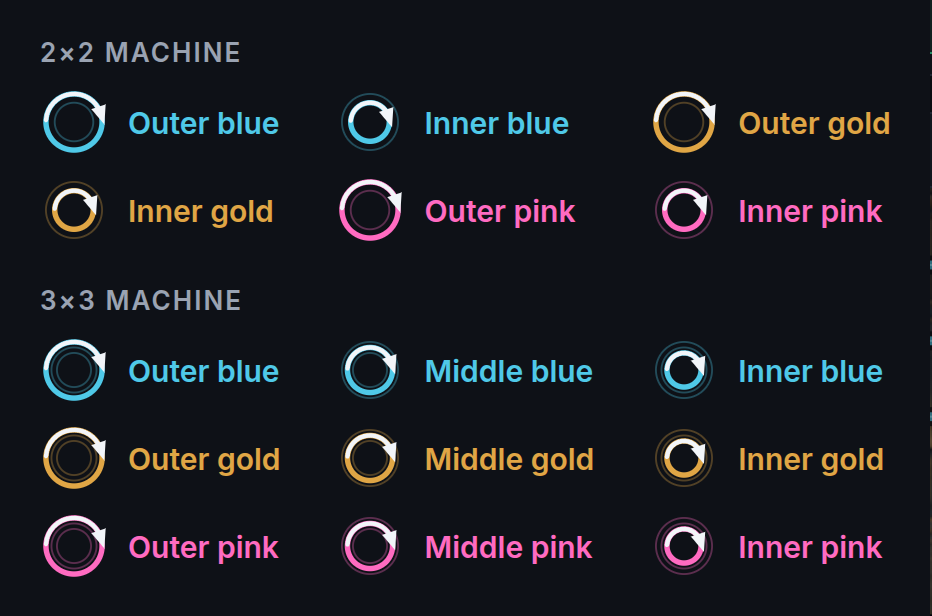
Which way
- Clockwise ↻ is the way a clock's hands move.
- Counterclockwise ↺ is the other way.
- Watch the whole circle: every bead on a ring slides together.
- The letter in brackets on a block, like (R), is the Rubik's cube name for that ring. You never need it to finish a level.
So a spin reads like this: Inner blue · clockwise.
Run, Step, and the rest
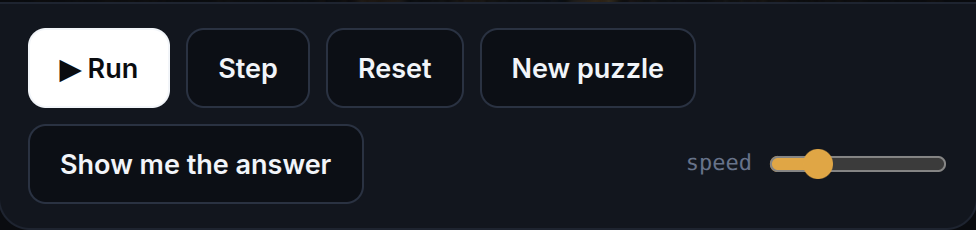
- ▶ Run
- Plays your whole program, top block to bottom, always starting from the beginning.
- Step
- Plays one block at a time. Use it to find exactly where a program goes wrong.
- Reset
- Puts the rings back to the start of the puzzle. Your blocks stay.
- New puzzle
- Deals a fresh puzzle of the same kind.
- Show me / Peek
- Help when you are stuck. Both cost the star for finding it yourself.
Read the rings
Watch a ring turn and name it. Then guess where a bead will land before it moves.
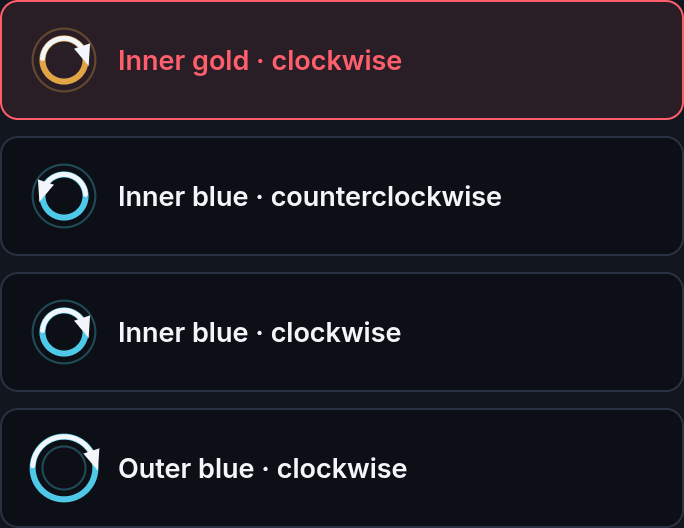
Watch levels: which circle, which way?
The algorithm
- Press ▶ Show me and watch.
- Find the circle that moved. Say its colour first, then outer, middle or inner.
- Decide the way its beads slid: clockwise ↻ or counterclockwise ↺.
- Pick the answer with both parts right. Not sure? Press Replay.
Predict levels: where does it land?
The algorithm
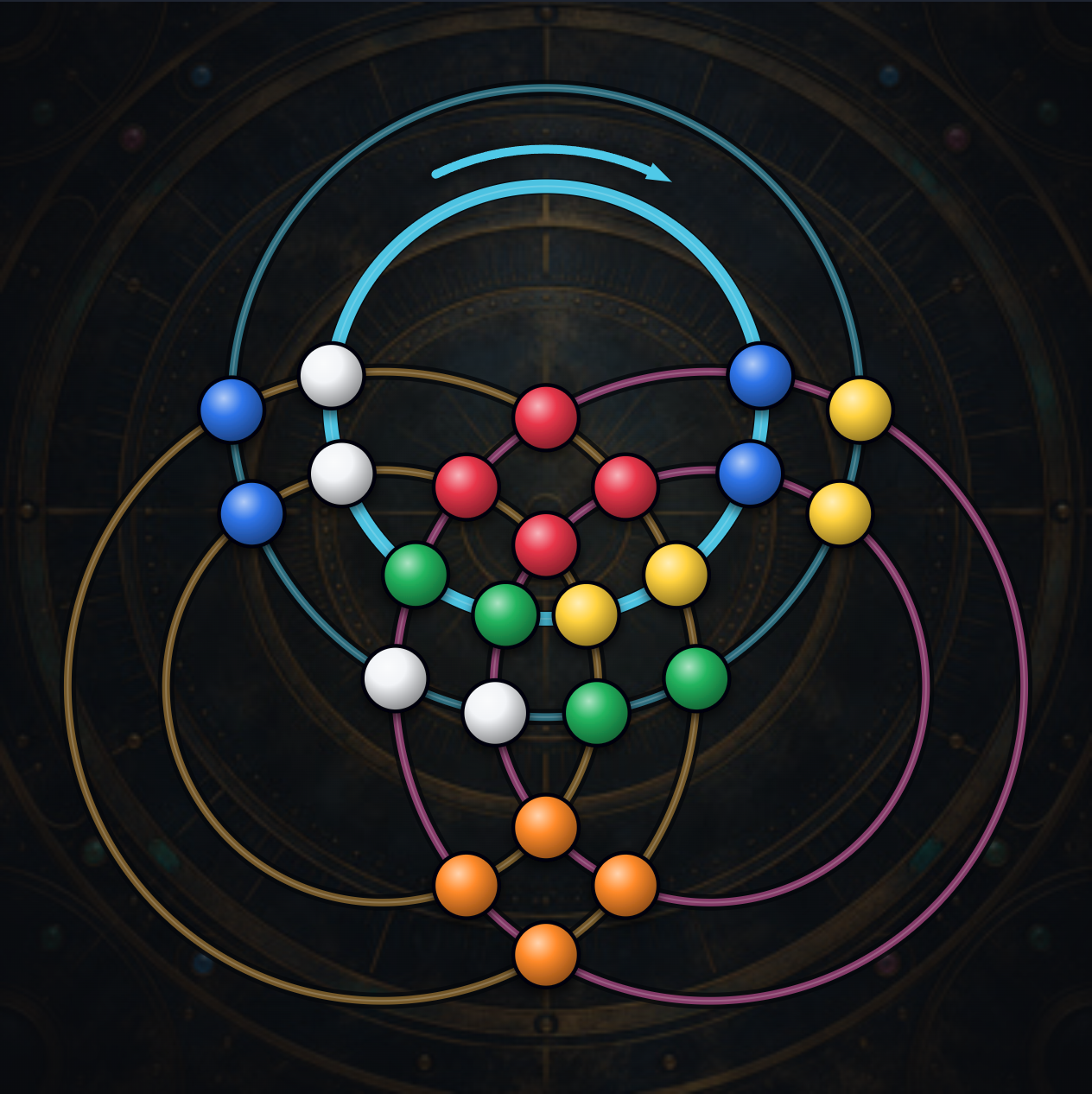
- Find the bead with the blinking white ring.
- Look at the arrow: that is the way its ring turns.
- Move along that same ring, the arrow's way, and count. On the 2×2 count 2 beads. On the 3×3 count 3 beads. Do not count the one you start on.
- Tap the bead you stop on. Stuck? Count it with me puts the numbers on the ring.

Mistakes to watch for
- Watching one bead instead of the whole circle.
- Naming the colour and stopping. Every colour has more than one circle.
- Moving the bead one place. A quarter turn is 2 places on the 2×2 and 3 on the 3×3.
Undo: your first programs
The game shows the spins that scrambled the rings. Your program has to put them back.
The undo algorithm
- Start at the bottom of the list: the last spin made is the first one you undo.
- Build a block with the same ring, turning the other way.
- Snap it underneath your last block so they click together.
- Move up the list one spin and repeat until you reach the top.
- Press ▶ Run. You should have exactly as many blocks as the list has spins.
Think socks and shoes: socks go on first, but shoes come off first. Reverse the order, and flip every direction.
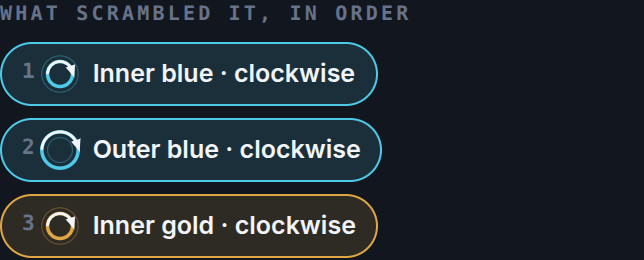
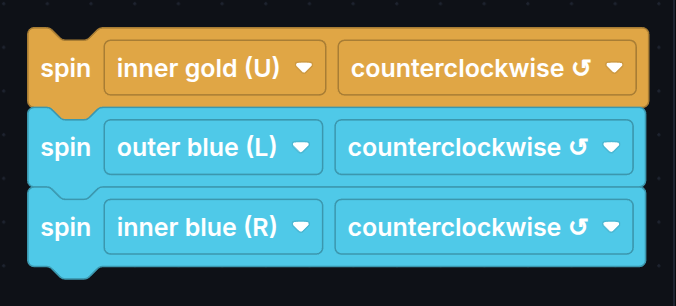
| Your block | Comes from list spin | List says | So you build |
|---|---|---|---|
| 1st | 3 (the last) | Inner gold · clockwise | Inner gold · counterclockwise |
| 2nd | 2 | Outer blue · clockwise | Outer blue · counterclockwise |
| 3rd | 1 (the first) | Inner blue · clockwise | Inner blue · counterclockwise |
Mistakes to watch for
- Playing it again: same spins, same way. That doubles the mess.
- Flipping the turns but keeping the order. That is only half of it.
- Reversing the order but keeping the directions. The other half.
- On the 3×3, forgetting the middle circles are rings too. They undo the same way.
Repeat and patterns
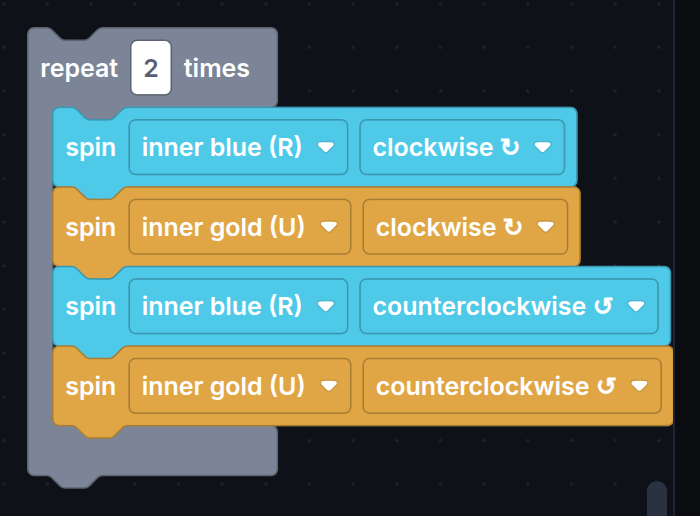
A repeat block runs the blocks inside it again and again. Programmers call it a loop.
How many times until home?
The algorithm
- The chunk is already inside a repeat block. Do not change the spins.
- Press ▶ Run. The coach tells you how many beads ended up home.
- Not home? Make the number one bigger and Run again.
- Stop at the smallest number that brings every bead home.
Good to know
- A repeated chunk always comes back home eventually. The number is something you can find, so do not guess.
- A different machine needs a different number. Test it every time.
Match the picture
The algorithm
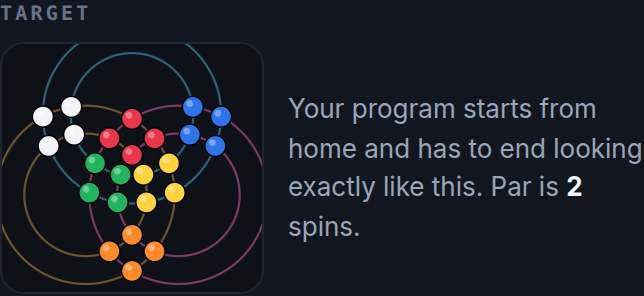
- Look at the target. Your program starts from home (every colour together).
- Find the colour groups that moved, and the ring that moves the most of them into place.
- Add one spin block for it and press Step. Closer to the target? Keep it. Not closer? Flip its direction or try another ring.
- Repeat until it matches. Par is how many spins it takes, so aim for that many blocks.
Mistakes to watch for
- Matching one colour at a time. Look for the ring that lines up most of the picture at once.
- Using outside rings on the checkerboard (3-4). That pattern only needs the three middle circles, twice each.
- Splitting directions on Six spot (3-5). There, every spin goes clockwise.
Chunks and fixing
Build a set of spins once, give it a name, and use it again. Programmers call that a function. Then you fix programs that almost work.
Name it once, use it twice
The algorithm
- Open the Chunks drawer and drag out the chunk block.
- Put the spins inside it, in order, from the Spins drawer.
- Open Chunks again. There is now a block with your chunk's name: that block calls it.
- Drag the call out as many times as you need, snap the calls together, and press ▶ Run.
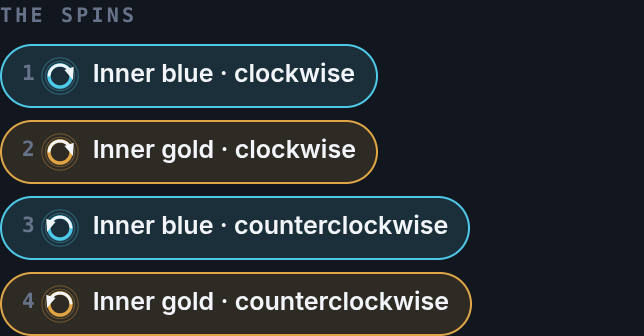
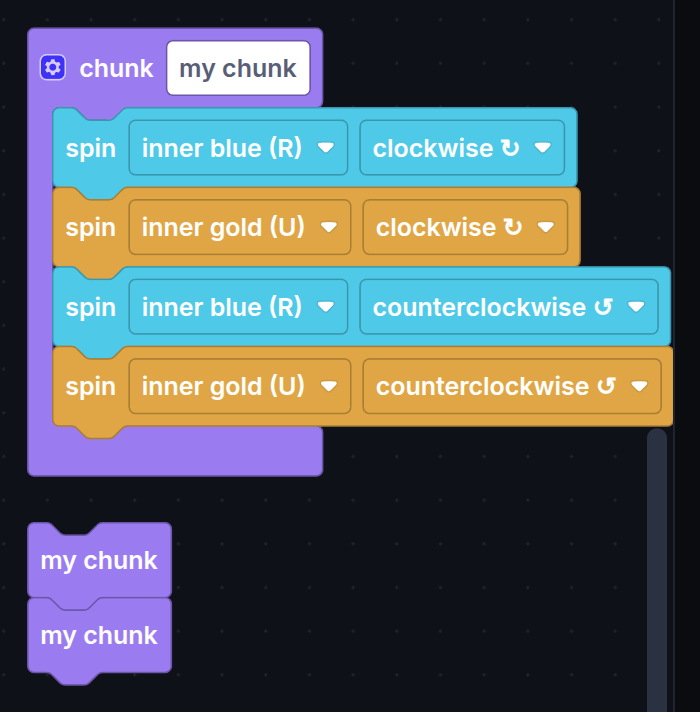
Set up, do the work, put it back (4-2)
- Set up: one spin that moves things into place.
- Work: your chunk.
- Put it back: the setup spin again, the other way.
Debugging: one block is wrong
The algorithm
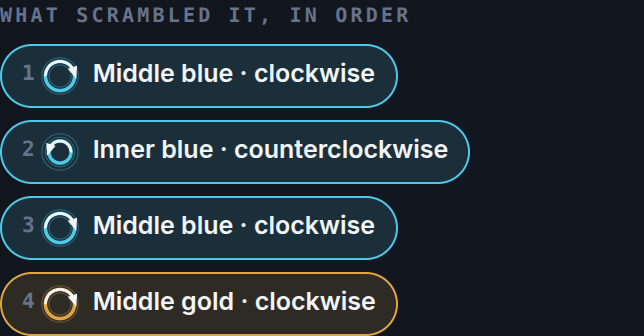
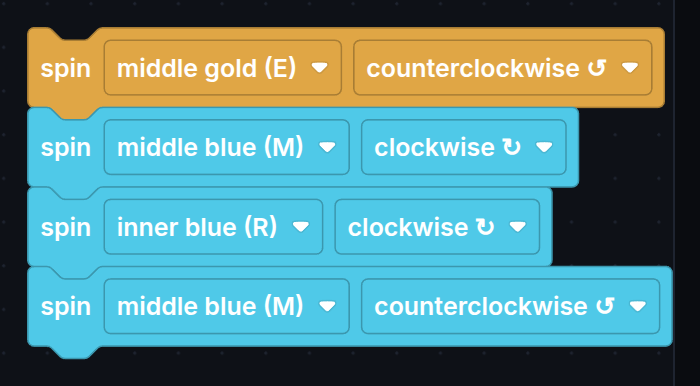
- Work out what the program should be, using the undo algorithm from Room 2.
- Compare it with the blocks, top to bottom, one at a time.
- Or press Step one block at a time. The spin that makes things worse is your bad block.
- Fix only that block. Do not rebuild everything. In 4-3 one block points the wrong way. In 4-4 two blocks are in the wrong order.
Mistakes to watch for
- Copying the same blocks twice instead of making a chunk.
- Forgetting to put the setup back.
- Rebuilding everything when only one block is wrong.
- Under par (4-5): taking the long way. A target made in four spins can be made in four spins.
Mastery: no list, no hints
The scramble is hidden. Read the machine itself and bring it home.
The algorithm
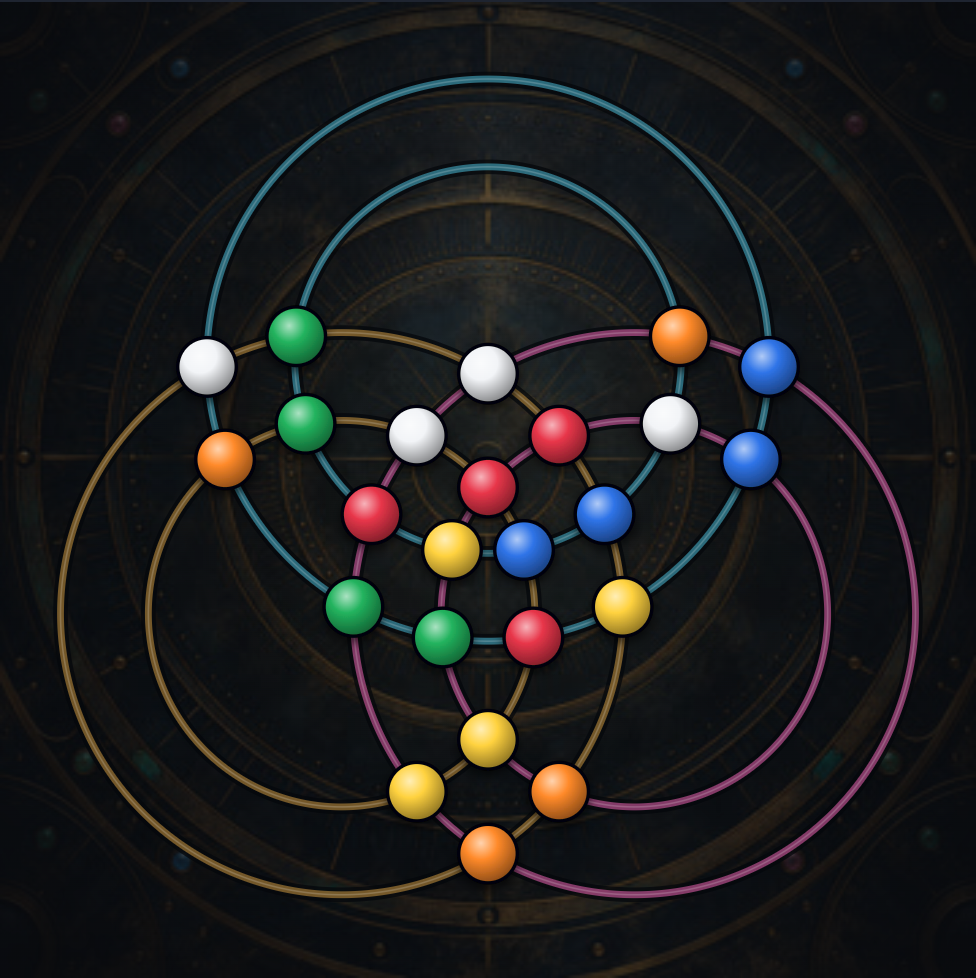
- Read first. Which colour groups are still together? The ring that split a group is a good place to start.
- Really stuck? Peek shows the last spin of the scramble, and that is the first one you undo (Room 2). It costs a star.
- Add one spin and Step it. More beads home? Keep it. Fewer? Flip it or change the ring.
- When it goes wrong, keep your good spins and change only the last one.
- On the 3×3 remember the middle circles. On the 4×4 count four rings in every colour, from the outside in.

Mistakes to watch for
- Spinning to see what happens. Read the rings first.
- Starting over every time. Keep your good spins.
- Mixing up the second and third circles on the 4×4.
5-5 The workshop is not scored. Scramble it, or type a real cube algorithm in letters, like R U R' U'.