The Night Ferry algorithm cheat sheet
An algorithm is a list of steps you follow in order. Every room of the Night Ferry has one, and they build on each other the same way the week does on the real V5 robot. Find your room, follow its steps, and check the example. Every picture here is a real screen from the game.
Read the screen

- ▶ Run ×5
- Runs your program as many times as the level asks, here five. One run proves nothing; the level wants the whole set.
- ■ Stop
- Stops the runs early.
- Logbook
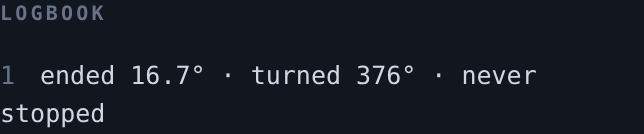
- One line per run: where it ended, how far apart the runs landed (the spread), and how many times it reversed.
- Heading · Target · Error
- On the water: where the ferry points, where you want it, and how far off it is right now.
- Brain
- Whatever your program prints, the same as the V5 Brain screen.
- Python
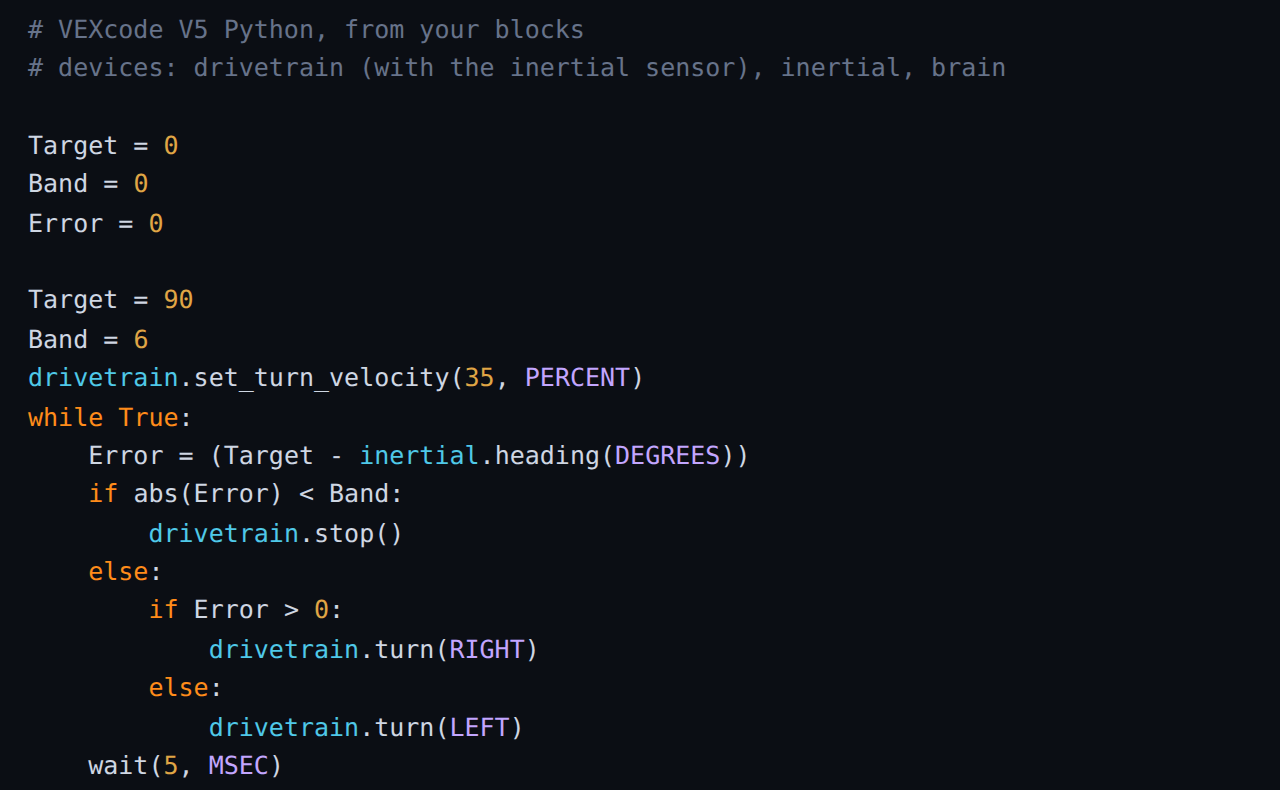
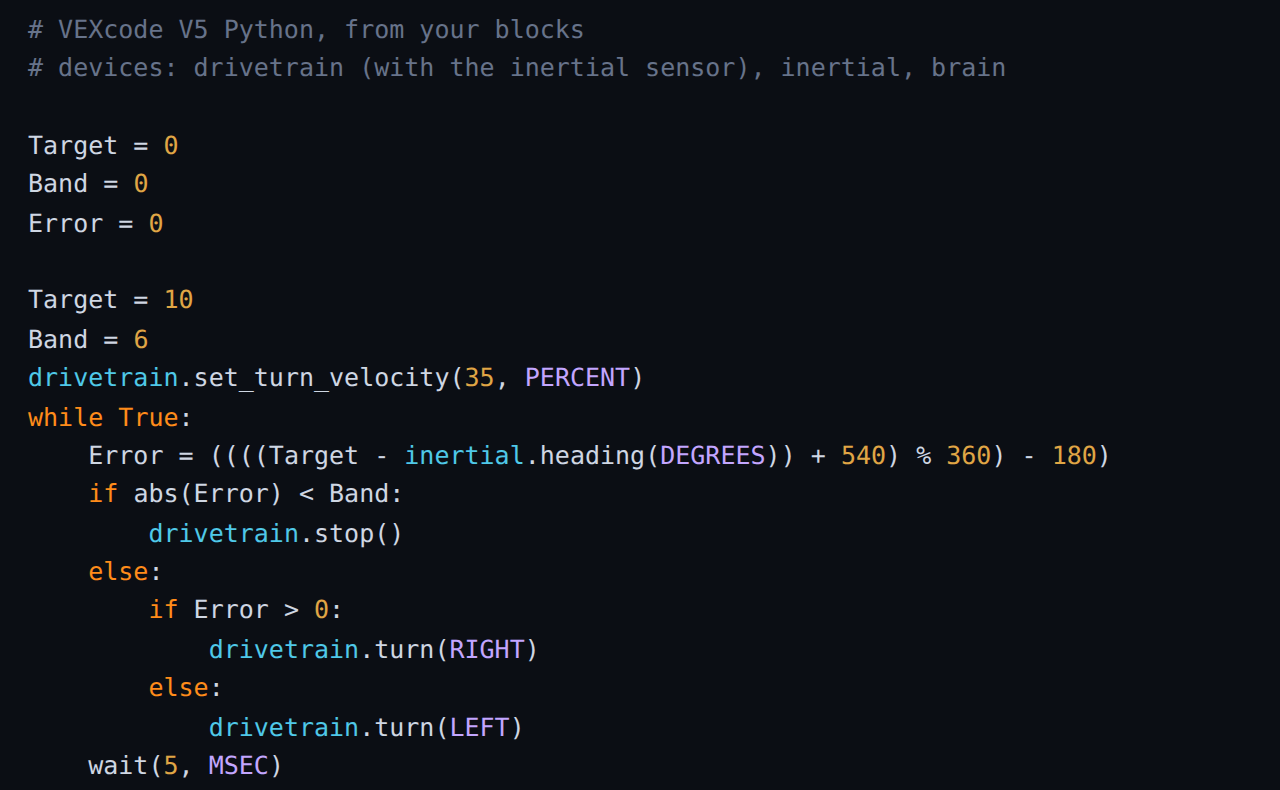
- Open VEXcode V5 under the blocks to see your program as Python. It is the same program, written as text.
- Show me the answer
- Loads a working program. It costs the "without Show me" star.
Three words the whole week uses
- Target: the heading you want, in degrees. 0 is north, 90 is east.
- Error: Target − heading. How far off you are, and which way.
- Band: how close counts as arrived.
Drive and turn on a timer
A program that moves for a set time, run five times, to see how much a timer can be trusted.
Cast off: drive on a timer
The algorithm
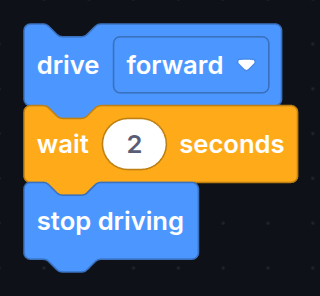
- drive forward: the motors start and keep going.
- wait 2 seconds: the program pauses while the boat moves.
- stop driving: the motors cut, and the boat coasts a little.
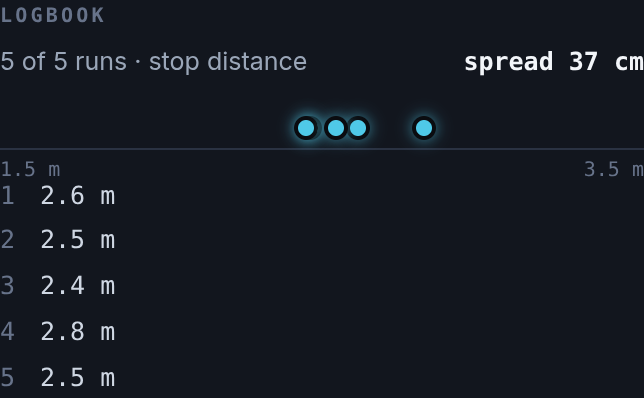
- Press ▶ Run ×5 and read the five stops in the logbook.
A timed turn: tune for the average
The tuning algorithm
- Build turn right, wait, stop driving, and Run ×5.
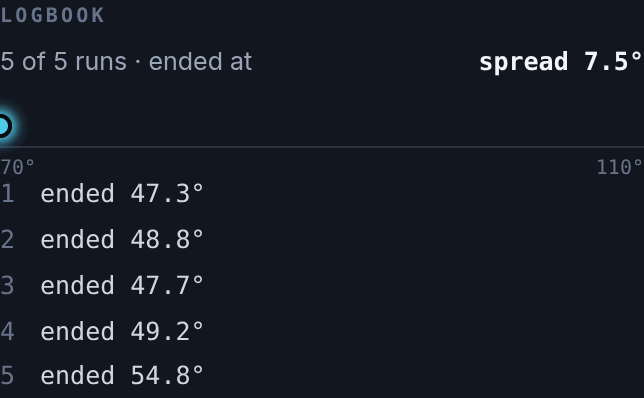
- Read the average of the five, not the best one.
- Average short of 90? Make the wait a little longer. Past 90? A little shorter.
- Change it in small steps and Run again, until the average is within 8° of 90.
- Then look at the spread. That is how far a timer turn wanders even when the average is right.
Mistakes to watch for
- Expecting the same stop every time. Same program, same boat, five different stops.
- Tuning until one run looks perfect. Tune for the average, then look at the spread.
Calibrate, read, and measure
The Inertial sensor gives the heading. It has to calibrate first, and it drifts over time.
Calibrate, and wait for it
The algorithm
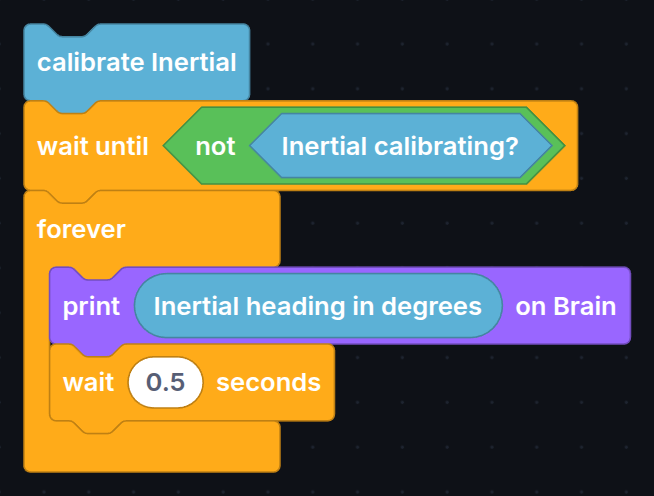
- calibrate Inertial: the sensor finds its own zero. The boat must be still.
- wait until not Inertial calibrating?: do not read anything until it is done.
- forever: print the heading on the Brain, then wait 0.5 seconds.
Measure the drift
The algorithm
- Run it. The boat is tied up and still for three minutes, printing every 10 seconds.
- Read the Brain at about 0:00, 1:00 and 3:00.
- Drift per minute = (reading at 3:00 − reading at 0:00) ÷ 3.
- Check it with the 1:00 reading: it should have moved about one minute's worth.
- Type your answer, in degrees per minute, into the logbook.
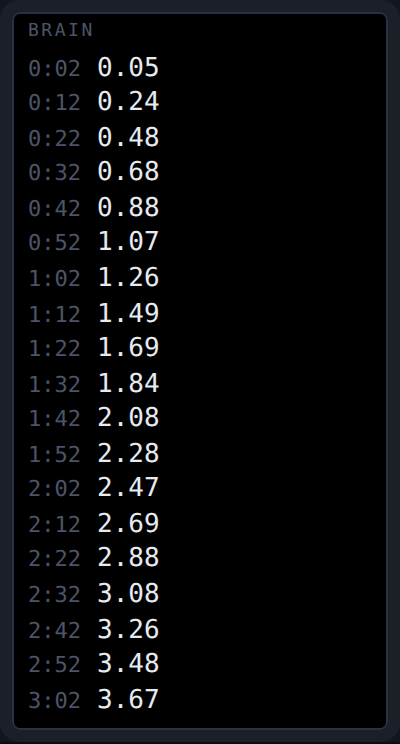
Your numbers will be different
- Every player's sensor has its own drift, faster or slower, up or down.
- Use your Brain readings, not these.
- A drifting heading is why the robot needs to steer by the sensor all the time, not once.
Mistakes to watch for
- Reading the heading while it is still calibrating. That number has not been decided yet, and nothing warns you.
- Saying "not much". Degrees per minute is a measurement; "not much" is not.
Steer by the compass
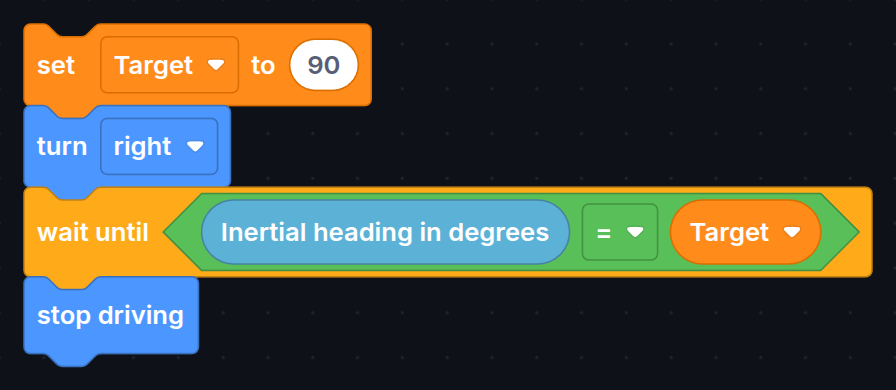
Turning until the heading equals the Target does not work. Steering both ways works, but it hunts.
Make it hunt: why equals fails
The algorithm
- Run the program you are given. Do not fix it yet.
- Watch the heading as it reaches 90. It goes past.
- Why: the heading arrives in steps (88.9, 89.8, 90.6) and skips the one exact number the program waits for.
Steer both ways
The algorithm
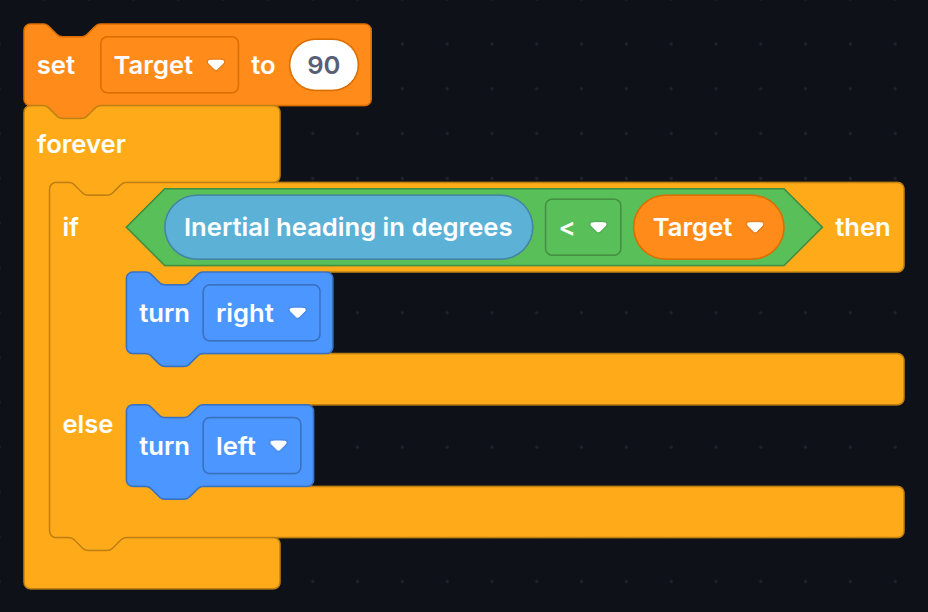
- set Target to 90.
- forever: if heading < Target then turn right, else turn left.
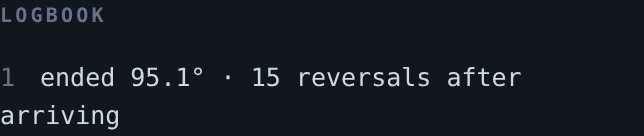
- Run it and count the reversals in the logbook.
Slow it down
The tuning algorithm
- Add set turn velocity at the very top.
- Lower the % a step at a time and Run.
- Read the wobble at the end of the run. Keep going until it is under 8° side to side.
- Too slow and it never reaches 90 in time. Go back up a step.
Mistakes to watch for
- Trusting equals with a sensor. Use < and >.
- Thinking it will settle. With only two choices, right or left, it never stops.
- Slowing it down so much it never gets there.
The deadband: close enough counts
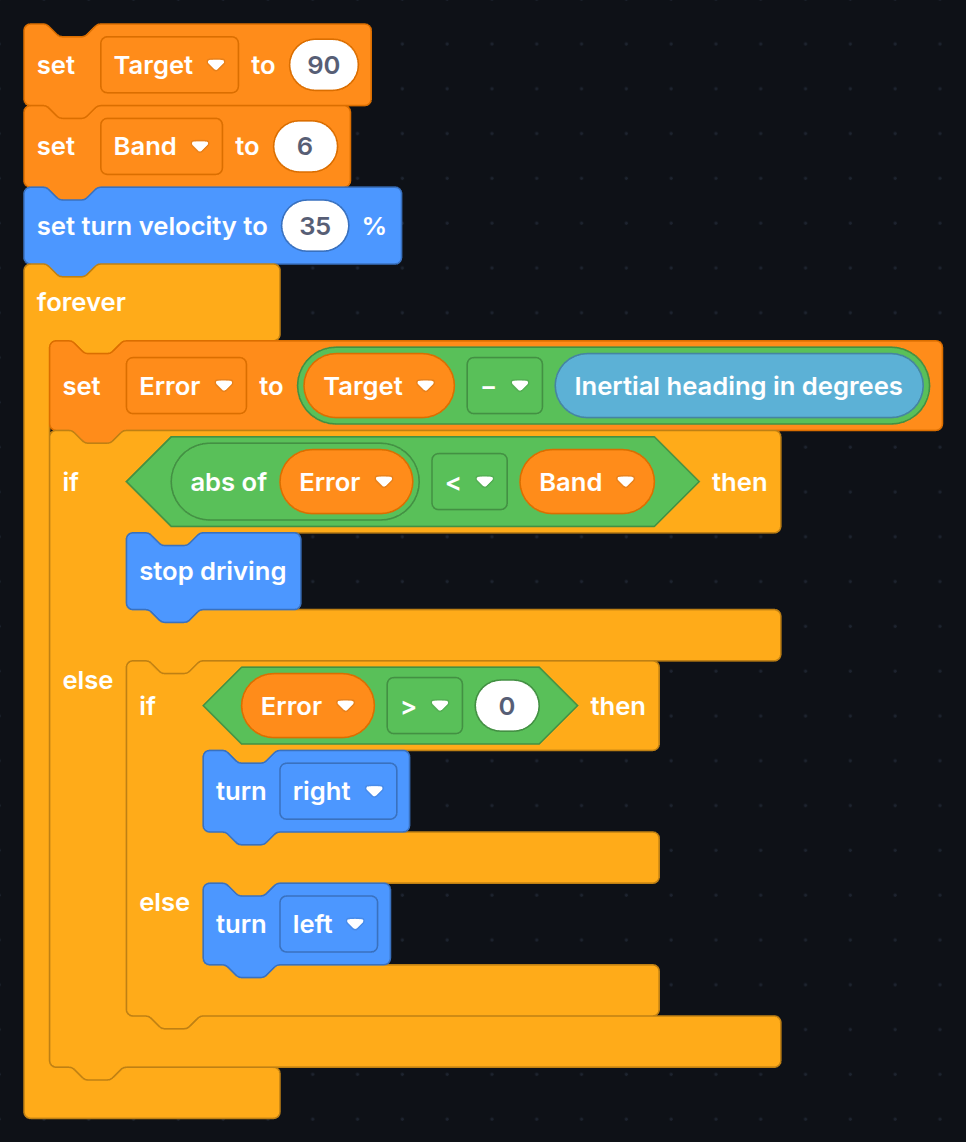
Give the program a third choice: when it is close enough, do nothing. That band is the deadband, like a held bumper.
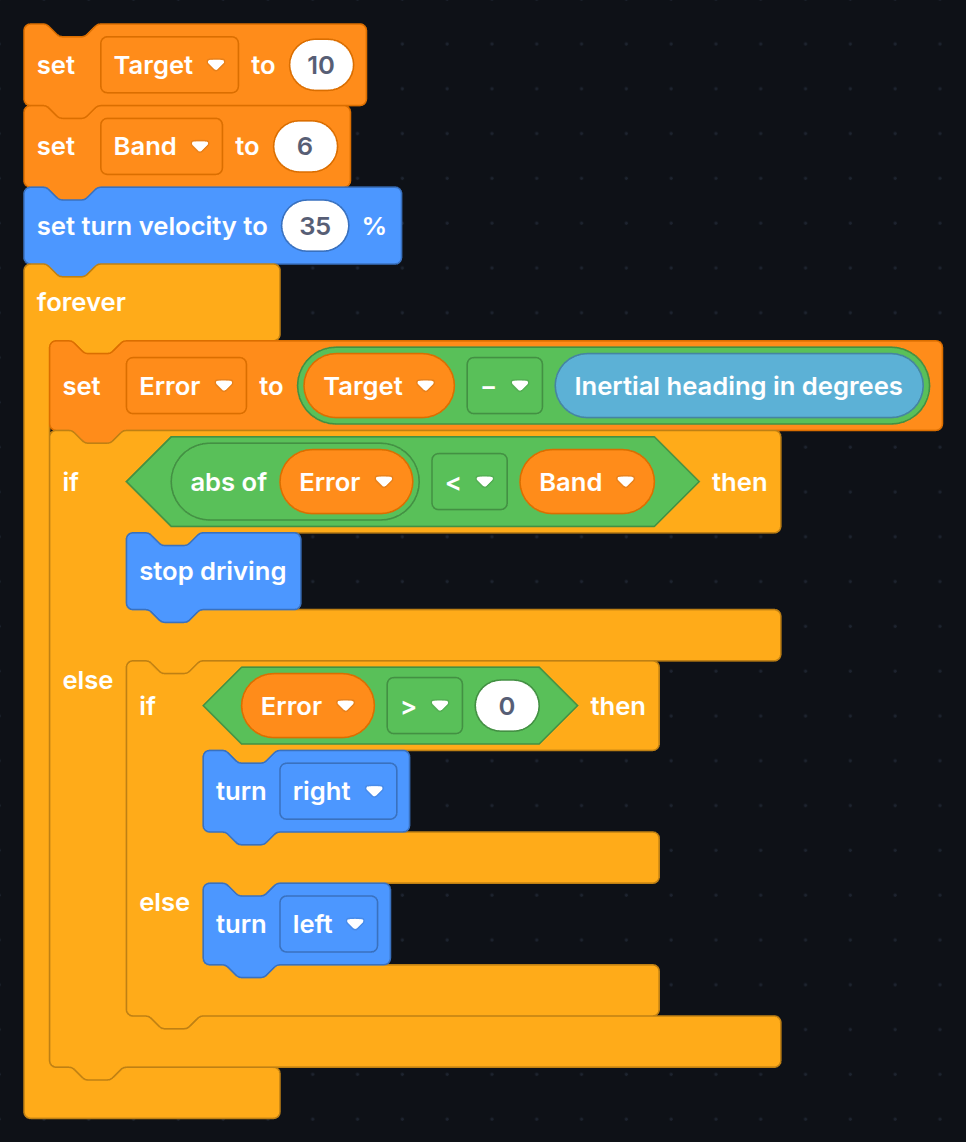
The deadband algorithm
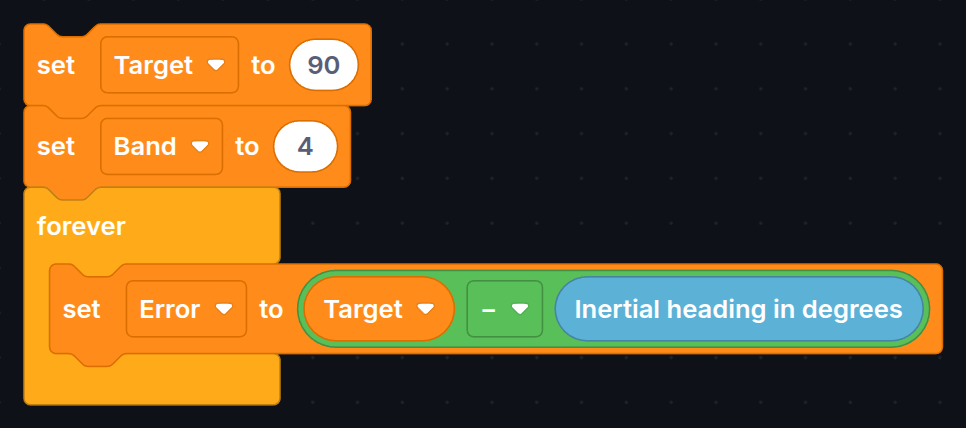
- set Target, set Band, set turn velocity.
- forever: set Error to Target − heading.
- if abs of Error < Band then stop driving. Close enough, from either side.
- else: if Error > 0 then turn right, else turn left.
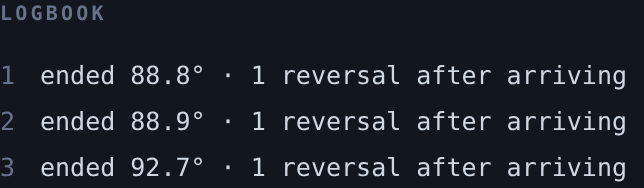
- Run all three. The goal is to stop once, cleanly.
Tuning the band (4-2 and 4-4)
- Still hunting (lots of reversals)? The boat coasts further than the band is wide: widen the band or turn slower.
- Stopping too far from Target? The band is too wide: shrink it.
- To find the narrowest band that works: start wide, shrink it a step at a time, and when it starts hunting, go back one step.
- A faster turn coasts further, so it needs a wider band (4-4).
Hold the line (4-3)
- Inside the band, drive forward instead of stopping.
- Outside it, turn back toward the Target.
- A turn stops the driving on this drivetrain, so the drive has to come back on inside the band.
Mistakes to watch for
- A band smaller than the overshoot. If the ferry coasts further than the band is wide, it still hunts.
- Leaving out abs of. Arriving from either side has to count.
- Thinking a wider band is safer. It is just less accurate.
Turn the short way across north
Heading is a circle, not a ruler: 359 and 1 are two degrees apart. Plain Target − heading can send the ferry the long way round.
The fold
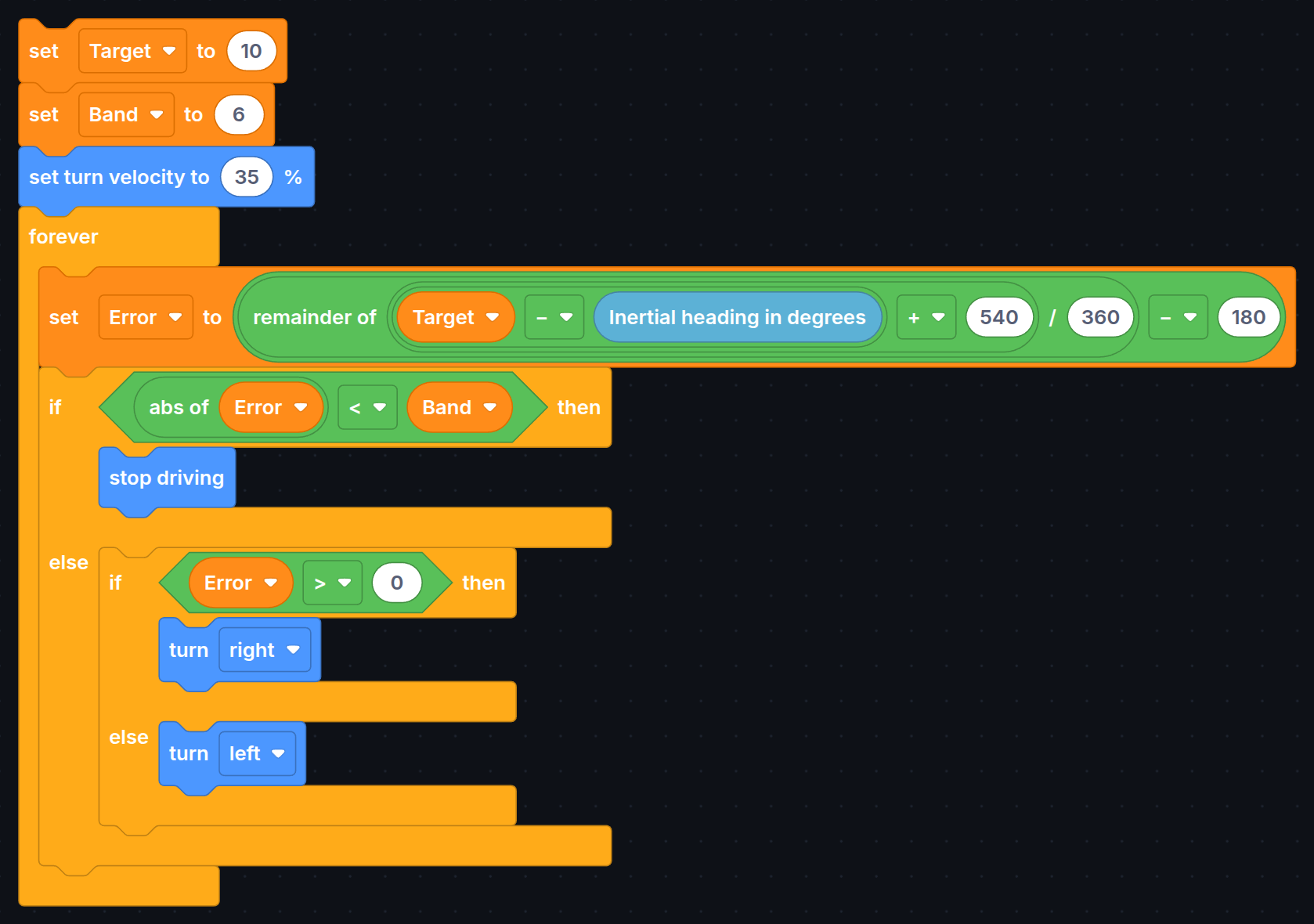
- Replace the Error with: Error = remainder of (Target − heading + 540) / 360, minus 180.
- That always gives a number from −180 to 180: the short way, and which side.
- Positive: turn right. Negative: turn left. Small: inside the band, stop.
| Step | Target 10, heading 350 | Means |
|---|---|---|
| Target − heading | 10 − 350 = −340 | 340° left: the long way |
| + 540 | −340 + 540 = 200 | never negative now |
| remainder of ÷ 360 | 200 | wrapped onto the circle |
| − 180 | 20 | 20° right: the short way |


The rest of the room
- Any heading (5-2) and the night crossing (5-5): the harbor master sets Target, so take your set Target block out. Every trip has to take the short way and stop, even 270 → 135, which never crosses north.
- Ten runs, measured (5-3): run your heading turn ten times against the timer turn from Room 1, and compare the two spreads in the logbook.
- As tight as it goes (5-6): band of 2°, 9 of 10 runs inside it. Change only the turn velocity: a tighter band needs a slower turn.
- The pilot's touch (bonus, 5-4): inside the loop, set turn velocity to abs of Error × a number. Start the number at 2 and ease it down until the ferry stops without rocking.
Mistakes to watch for
- Treating heading like a ruler. It is a circle.
- Testing only the turns that cross north. The fold has to get every turn right.
- Calling it from one good run. Ten runs is a measurement; one run is an anecdote.
- Shrinking the band and keeping the speed. A tighter band needs a slower turn.